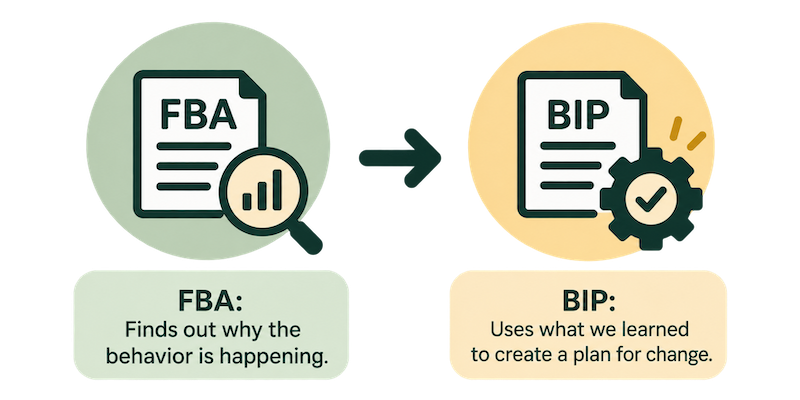
Understand Why a Behavior Is Happening and What to Do Next
When behavior is challenging, simply trying to stop it may not address why it keeps happening.
Our Board Certified Behavior Analysts (BCBAs) use a behavior-analytic approach to understand what may be contributing to behavior and develop individualized recommendations based on what we learn. Understanding behavior comes first. Intervening on the behavior second.
What Is a Functional Behavior Assessment (FBA) and Behavior Intervention Plan (BIP)?
Functional Behavior Assessment (FBA)
A Functional Behavior Assessment (FBA) helps us understand why a behavior may be happening. Our Board Certified Behavior Analysts (BCBAs) look at:
The behavior and when it occurs.
What happens before and after it.
Environmental factors and patterns.
Relevant skills and possible unmet needs.
Information gathered across people, places, and situations.
The goal is to understand what may be influencing the behavior so recommendations address the reason behind it—not just the behavior itself.
Behavior Intervention Plan (BIP)
A Behavior Intervention Plan (BIP) uses information from the FBA to create a clear, practical plan. Depending on what we learn, it may focus on:
Preventing challenging behavior when possible.
Changing things that may be contributing to the behavior.
Teaching useful replacement skills.
Building communication, coping, or independence.
Helping caregivers and teams respond consistently.
A strong BIP is individualized. It connects what we learn about why a behavior happens with what to do next.
What Can a Functional Behavior Assessment and Behavior Intervention Plan Help With?
CHALLENGING, CONFUSING, OR PERSISTENT BEHAVIOR
Understand behavior that is frequent, intense, disruptive, unsafe, varies across situations, or continues despite strategies that have already been tried.
UNDERSTANDING WHY BEHAVIOR HAPPENS
Identify patterns across people, places, routines, expectations, situations, and what happens before and after the behavior to better understand what may be contributing to it.
COMMUNICATION & SKILL BUILDING
Identify communication, coping, self-advocacy, participation, or other meaningful skills that can help the person meet the same need in a more effective way.
PREVENTION & ENVIRONMENTAL CHANGES
Identify changes to routines, expectations, interactions, or environments that may reduce barriers, prevent challenging situations, and make success more likely.
CONSISTENCY ACROSS PEOPLE & SETTINGS
Develop clear, practical guidance so families, educators, and other important people share an understanding of the behavior and know how to respond consistently across settings.
WHEN CURRENT STRATEGIES AREN’T WORKING
Take a closer look when an existing FBA, BIP, recommendation, or other strategy isn’t producing meaningful progress and determine what may need to be better understood or changed.
Frequently Asked Questions About FBAs & BIPs
Have specific questions about FBAs and BIPs? We’ve gathered the most common questions on this page. For questions about other services, visit the main FAQs.
Do FBAs and BIPs always go together?
Not always. A Functional Behavior Assessment (FBA) helps us understand why a behavior may be happening. A Behavior Intervention Plan (BIP) uses those findings to guide what to do about it. An FBA does not always require a BIP. But when a BIP is needed, it should be based on what was learned through the FBA. Assessment should guide intervention, not the other way around.
What happens during an FBA?
A Board Certified Behavior Analyst (BCBA) completes the Functional Behavior Assessment (FBA). The process may include reviewing records and data, interviews, direct observation, and data collection to better understand patterns surrounding the behavior. The timeline for how long an FBA takes can vary greatly depending upon the complexity of the scenario.
Can Mason Dixon review an FBA or BIP that has already been completed?
Yes. We can review an existing assessment or plan when questions remain, behavior continues, progress is limited, or you are concerned that the recommendations do not adequately address why the behavior is happening.
Are FBAs and BIPs based on Applied Behavior Analysis (ABA)?
Yes. FBAs and BIPs are grounded in ABA principles. Our BCBAs use a behavior-analytic framework to examine patterns, environmental variables, relevant skills, and behavioral function.